


Black Friday 2024 and SEO for AI Shopping Assistants
As Black Friday 2024 approaches, scheduled for 29 November, the usual whirlwind of deals and promotions is intensifying, promising unmissable discounts on a vast range of products and services. However, the abundance of offers can easily overwhelm consumers, making it difficult to tell genuine bargains from mere marketing strategies.
In this context, two technological innovations are emerging that are set to revolutionise the shopping experience: Perplexity’s “Shop Like a Pro” and Amazon’s “Rufus”. These AI-powered virtual assistants aim to simplify the decision-making process, offering personalised recommendations and making it easier to navigate the countless offers available.
Table of Contents
Shop Like a Pro by Perplexity
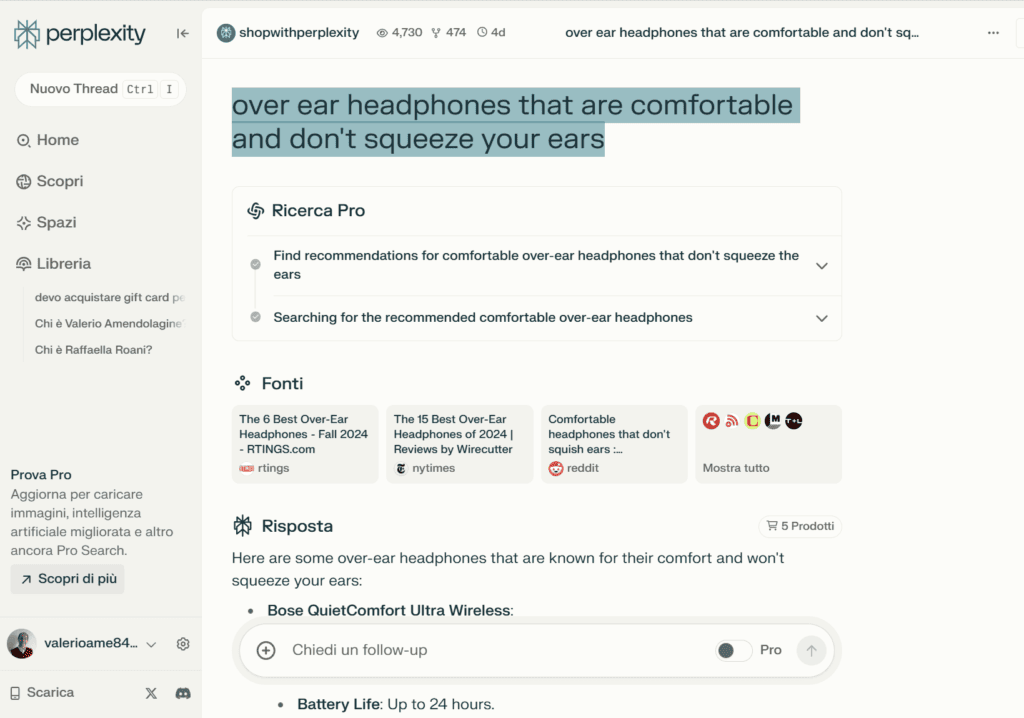
Perplexity, known for its advanced AI-powered search engine, has introduced “Shop Like a Pro”, a feature that allows users to search for and buy products directly through the platform. This innovation offers an integrated shopping experience, making it possible to compare prices, read reviews and complete transactions without having to switch sites. Currently, “Shop Like a Pro” is available to Pro users in the United States, with the intention of extending the service globally in the future.
Rufus by Amazon
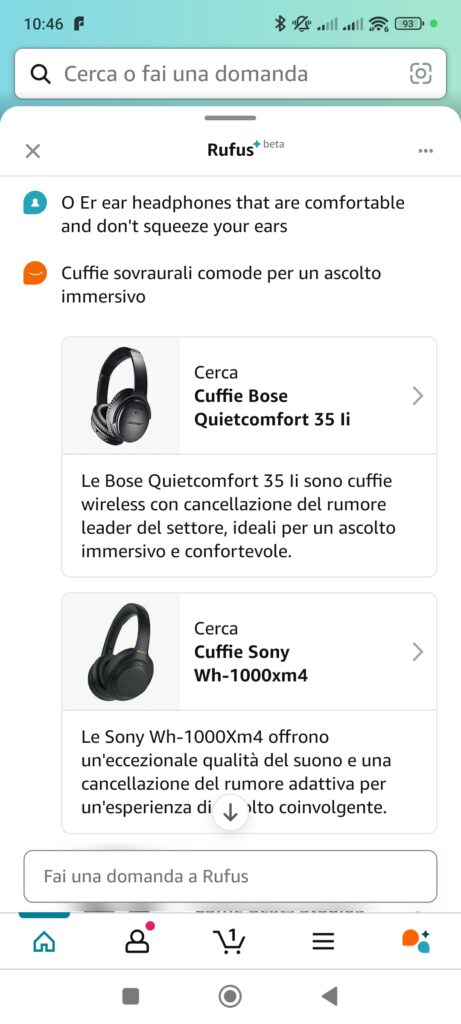
Amazon has launched “Rufus”, a virtual assistant based on generative AI, designed to improve the shopping experience on Amazon.it. Rufus is able to answer customer questions, suggest specific products, compare options and provide personalised recommendations, making it easier to discover new items. Initially available in the Amazon app for a selection of customers, Rufus will be progressively rolled out to all users in Italy over the coming weeks.

The challenge for Google and price comparison sites
These new assistants are changing the way we shop and the way we research for shopping. Google, for example, could take a hard hit, considering that many product searches may shift directly towards assistants like Rufus and Perplexity. But that’s not all: price comparison sites such as Trovaprezzi, Kelkoo, Idealo and others could find themselves in difficulty. Their business model, based on aggregating offers and on traffic generated by comparison searches, risks being overtaken by assistants capable of providing immediate and complete answers, reducing the need to browse external platforms. The biggest risk? Becoming obsolete, unless they evolve by integrating comparable AI features.
E-commerce SEO: the new rules of the game
The advent of virtual assistants like Rufus and “Shop Like a Pro” will profoundly redefine SEO strategies for e-commerce. It will no longer be just about ranking at the top of a search page, but about becoming a preferred source for AI answers. This requires a shift in mindset: the data provided by e-commerce sites must be structured, complete and easy to interpret, both for people and for artificial intelligence systems.
Optimising product pages
Product pages will no longer be just an element of information for customers, but the basis for the “conversation” between the site and the AI assistant. For this reason, it is essential to:
- Enrich structured data with detailed information such as price, availability, dimensions, colours and materials. Elements like schema.org can be used to standardise this information and make it more accessible.
- Improve the quality of images and videos, ensuring visual descriptions that complement the textual ones.
- Include user reviews and ratings, which not only help build trust, but can also be used by assistants to formulate personalised suggestions.
The role of FAQs
FAQs will be a key element for improving ranking and relevance. Every e-commerce site should:
- Analyse customers’ most frequent questions to create content that answers them clearly and completely.
- Use FAQs to educate consumers, adding explanations about materials, the differences between models, usage tips and other practical information.
- Update FAQs regularly to ensure they are always current and relevant.
Original, in-depth content
AI assistants will favour content that stands out for its depth and authenticity. E-commerce sites will need to:
- Invest in unique product descriptions, avoiding copy-and-pasting the descriptions provided by manufacturers, which come across as generic and penalising.
- Produce related guides and articles, such as tutorials, usage tips or product comparisons, which not only attract the attention of AIs, but also strengthen the site’s authority.
- Adopt an original point of view, using a communication style that reflects the brand and captures users’ interest.
The new SEO is relational
Finally, it is not just about providing data and content, but about doing so in the most “relational” way possible. AIs look for reliable, complete sources that show attention to detail. The e-commerce sites that manage to establish an effective dialogue with these assistants will be the true winners of the new digital landscape.
The future of AI Shopping Assistants
Looking further ahead, AI shopping assistants will not merely aggregate information: in the future, they will be able to draw on an in-depth knowledge of users’ tastes, both expressed and unexpressed. This opens up a scenario in which control of these tools will become an extremely powerful weapon for influencing the market. The companies that own these AIs will have unprecedented power to shape preferences, create trends and steer consumer choices, much as Google has done up to now. A responsibility that requires transparency and regulation to avoid manipulative drifts and that, on the business side, forces us to start planning a new type of promotion and communication right away. Is your company ready? Let’s talk about it!
Related service: discover AI-gmented Solutions by ARvis — the agency that scales with you.