


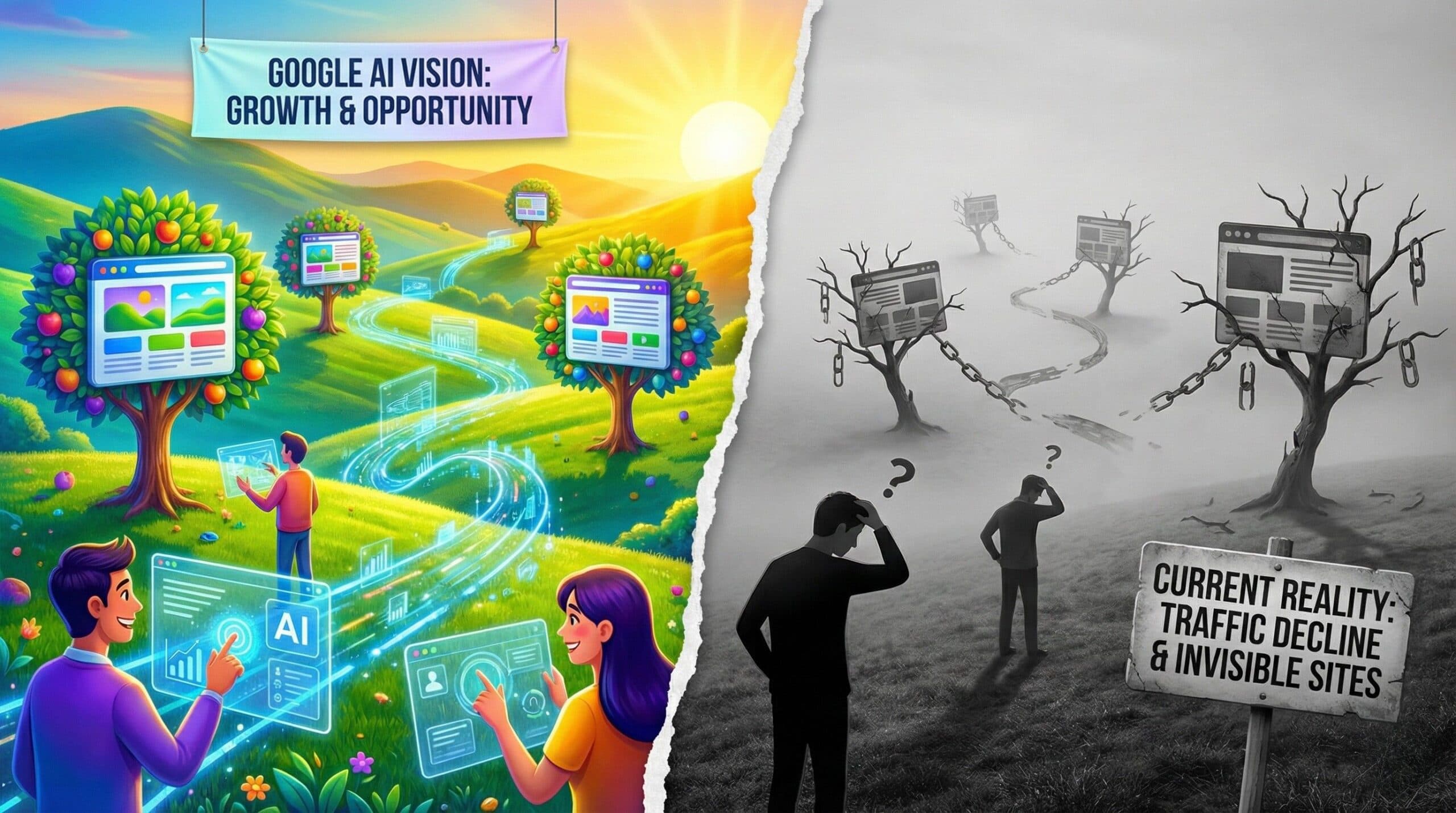
Google’s AI Utopia vs. the Harsh Reality of 2025: Why Your Traffic Collapsed (and How to Recover in 2026)
If you read what Mountain View published, titled “AI-powered search behavior“, it feels like living in the best of all possible worlds. Google paints a future – in fact, a present – in which Artificial Intelligence not only improves the user experience but creates “new growth opportunities” for businesses.
For anyone running a website, an e-commerce store or a publishing portal, however, 2025 was not the year of opportunity. It was the year of silence. Fewer clicks, fewer visits, declining revenues.
We analyzed Google’s document point by point, comparing it with the reality “on the ground”. A merciless comparison that explains why the old web is dying and what your company needs to do to survive the Agentic AI revolution.
Table of Contents
1. The “Complex Searches” Trap
What Google says:
“Queries in our AI Mode experiences are getting longer and more complex. We believe this shift will help shorten the time between discovery and decision.”
The Current Reality: It’s true, users are asking more complex questions. But the reality Google leaves out is that the answer is delivered directly by the AI on the results page (SERP). What Google calls “shortening the time” means, for a site owner, zero clicks. Your site, built and layered over the years to answer bare keywords (“Best running shoe 2024”), is now invisible to an AI that tries to “reason”. If the AI reads your information and summarizes it for the user, you provided the value, but Google kept the traffic. The result? A vertical collapse in visits in 2025 for every “old-school” site.
2. The Illusion of Instant Inspiration
What Google says:
“The gap between ‘I see it’ and ‘I want it’ is disappearing. Consumers can act on inspiration instantly… AI has turned both the physical and digital world into a showroom.”
The Current Reality: The gap disappears because there’s a middleman: the AI Agent. Most current websites are technically unprepared to converse with these agents. They were written for humans and for the old SEO crawlers (H1 titles, meta descriptions, keyword density). But an AI Agent doesn’t “read” like a human; it looks for structured data, relationships between entities and logical contexts. If your site doesn’t speak this language, then as far as the AI is concerned your product in the “showroom” doesn’t exist. In 2025, many e-commerce stores saw their product pages ignored because the AI couldn’t correctly extract their features to compare them with competitors right there in the chat.
3. “The Growth” vs. The Revenue Collapse
What Google says:
“Those who embrace AI are seeing stronger growth. It’s a behavioral change, not just a search update.”
The Current Reality: The accurate sentence should be: “Those who have radically restructured their online presence for AI are seeing growth”. Everyone else – the vast majority – is seeing a sharp drop in traffic and revenue. Traditional websites became obsolete within a few months. Years of layered “old SEO” suddenly became dead weight. 2025 punished those who waited, those who believed that writing a few articles with ChatGPT was enough to “do AI”. It isn’t. The problem is structural.
2026: Setting Things Right with ARvis.it
The good news? The traffic hasn’t disappeared, it has simply shifted and changed shape. It’s no longer “search” traffic, it’s “agentic recommendation” traffic.
If 2025 was the year of shock, 2026 must be the year of restructuring. You don’t need to rebuild the site to make it “prettier” to human eyes. You need to make it “understandable” to machines.
This is where ARvis.it comes in. Our mission for 2026 isn’t to do SEO the way it was done in 2020. It’s to prepare your company for the era of Agentic AI.
How do we help you recover the ground you’ve lost?
- From Keyword to Entity: We transform the structure of your content so that Google (and the other LLMs) don’t just see “text”, but unambiguous “data and concepts”.
- Advanced Semantic Markup: We rewrite your site’s invisible code so that AI Agents can extract prices, availability and answers without hallucinations. This turns you back into the “cited (and clicked) source”.
- Optimization for the Direct Answer: If the user doesn’t click, we need to make sure your brand is the only answer the AI provides. We work on Brand Authority to make you the source that can’t be bypassed.
Google is right about one thing: the revolution is here. But it’s wrong to say everything will be fine without effort. The old sites are dying. Contact us to build the digital infrastructure that will let you stop being at the mercy of AI and finally start leveraging it.
Related service: discover AI-gmented Solutions by ARvis — the agency that scales with you.
ARTICOLI CORRELATI

 How SEO Is Changing with Google’s New AI Mode: a practical guide to getting cited by artificial intelligence