


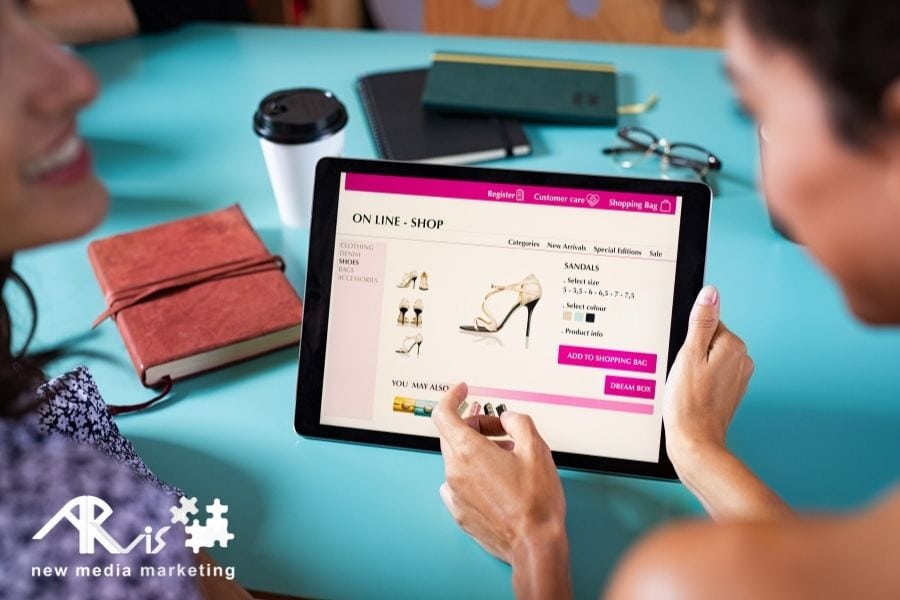
Selling Shoes Online: Tips on E-commerce and Social Strategy
How do you sell shoes online? At first glance, you might think that selling shoes is like selling any other item of clothing. In reality, selling footwear online involves a few more pitfalls. Online shopping has grown dramatically in recent years, and one sector with great potential is footwear. But how do you sell shoes online? What information should you give buyers about your product to make their choice easier? And then, which channels are best to focus on? Here is everything you need to know before starting a business that is constantly growing and evolving, with many opportunities but also plenty of competition.
Table of Contents
Why Choose to Sell Shoes Online
We have to start from a consideration that is as drastic as it is inevitable. The pandemic changed our habits forever, especially as consumers. The trend had already been clear for a few years; COVID accelerated the process: the rate of online purchases is steadily growing and is set to rise further. SendCloud’s report noted that 54% of consumers increased their online shopping during the pandemic, then kept this habit even after the restrictions ended. For shoes, too, it is no longer necessary to go to the store, dealing with traffic, parking, and queues at the checkout, to buy the most suitable or most fashionable model. Digital purchasing is simple and fast. What is more, by deciding to sell your product online, you will have a store that is always open. There are no set hours; you can be visible 24/7, with no limits of time or space. The potential audience, the communication strategies, and the opportunities to customize your business are certainly greater than with a physical store. This alone would be enough to understand why it is worth choosing to sell shoes online.Opening an E-commerce Store to Sell Shoes Online
Our advice is to build your own e-commerce store, and thus leverage your brand, if one already exists, to move online, or create one specifically for e-commerce. There are already several ready-to-use platforms for building the site. The choice depends mainly on the size of the store, and therefore on the quantity of products you sell. But e-commerce is no walk in the park: it is not enough to set up a nice site and wait for customers to arrive. There is a lot of work to do to make the site usable, to facilitate purchasing, to raise awareness of the online store, to get an adequate return on the investment, and so on. In short, the advice is to rely on a consultant or a specialized agency that follows every step. All of this applies to any e-commerce store.But what does a footwear e-commerce store require?
What Information Should You Give Buyers to Sell Shoes Online?
Many potential buyers are hesitant when it comes to buying shoes online because of the impossibility of trying them on, as they are generally used to doing in physical stores. That is why anyone selling shoes online must provide a large amount of extra information. It is not enough to state the color and the materials the shoes or boots are made of, and even the shoe size is not enough. In fact, even when shopping in a store, people often try at least two sizes, their own and perhaps one size larger or smaller based on the salesperson’s advice. This advice should always be present online too when selling a product as important to comfort as, indeed, shoes. You can also add a note stating whether the shoe has a wide or narrow fit. It is also extremely important to always report the exact heel height, even for the lower models. Finally, you can include a table matching the foot measurement in cm with the corresponding size for that particular pair of shoes. All this extra information will convince users that the online store is reliable, because it provides transparent information, and will therefore encourage the purchase.Logistics
Of course, with an online business you risk losing the romance of the traditional store. By now, the physical store has taken on a nostalgic, vintage charm, which online selling must try to make up for by conveying the same emotions. That is why the e-commerce store must be structured impeccably, and must be well cared for from the SEO standpoint in order to be visible to search engines. Not only must it enable a high-level user experience, guiding the user throughout the entire customer journey up to the purchase and even beyond. Because this is where, almost paradoxically, the most important part comes in. The consumer’s journey does not end with the purchase. You need to create a bond that leads the user to have a fond memory of the experience, to return to the site, and to leave positive feedback. This is done by setting up an adequate logistics service, with safe and fast shipping. It is then important to send a confirmation message for the order received that allows the purchased package to be tracked. At this stage, customer service must always be available, providing the right answers quickly. Finally, it is important to thank the user, inviting them to leave feedback, a review, or to post a photo of their new purchase on social media, perhaps with a dedicated hashtag.Fast and Secure Returns
Another essential service in selling shoes online is returns. Once again, the winning logic of the physical store is trying the shoe on your own foot, which online does not allow. However abundant and precise the information provided on the site may have been, the final try-on remains decisive. If the buyer is not completely satisfied with the product, they might never come back or, worse, could become a vehicle for negative criticism. But if they discover that a shoe that does not fit as imagined can be returned without any trouble, they will not complain about the store, and at most will be dissatisfied with the individual product. The ideal return is a free one, as is delivery. Users greatly appreciate that little word “free,” especially when associated with delivery. But not all stores are big enough to be able to afford it. So if it really is not possible, it is best to keep these costs to a minimum, making sure they are truly a small percentage of the product’s value.An Alternative for Starting the Business
Alternatively, if having your own store becomes too costly, you can start by listing your products on existing e-commerce platforms while waiting for the business to grow enough to allow you to “go it alone.” In fact, there are already numerous platforms and applications where you can list your products and sell online. For example, e-commerce aggregators are often a starting point for those who want to start from scratch. Amazon, too, can be defined as an aggregator, and it lets you create a mini store with a certain number of products inside it. Social networks themselves offer the possibility of creating storefronts and shops on their own channels, leveraging their large number of subscribers. Of course, having your own e-commerce store is another matter. Especially when it comes to the brand, an aggregator can be a starting point, or a complement, but without your own online store it will not reach the same value. In any case, at least at the beginning, you will have to plan for an investment in communication and advertising. In both cases, social media can be a great help.E-commerce and Social Media to Sell Shoes Online
Social media is a truly important tool that you cannot do without for a genuinely effective marketing strategy , especially for fashion-related products that require particular attention to image, such as footwear. Not only the classic Facebook and Instagram, on which you can add actual product cards. Both will also be very important for brand storytelling, as well as for advertising campaigns. Given how widespread it has become over the past year, it would be a mistake not to invest in TikTok , with its viral, easy-to-consume videos. The video format itself turns out to be the most appreciated by users, as the data also shows. The Visual Networking Index by Cisco* estimates that in 2022, 82% of traffic will come from video content. Finally, not to be underestimated is Pinterest, with the possibility of creating dedicated boards that link directly to the website. This social network can be very important for building a real market niche. To build customer loyalty and enter the world of online selling, Pinterest is an excellent solution. A less saturated and mainstream channel, but growing strongly and much appreciated for its visual content.Community
On social media it is important to always be present. Not only to tell your brand’s story and advertise products, as mentioned above. Your presence serves to build a relationship with customers, going on to create a real community. The goal must be to entertain users, creating engagement with content that interests them regardless of any potential conversion. Give users room to express themselves, so they can comment, share their experience, and voice their opinion. The social channels will become that virtual meeting place where people exchange opinions and ideas, replacing the physical store for an even more complete experience. It will be the users themselves who provide valuable advice and information, if you let them do so freely, without filters, naturally excluding gratuitous insults. It is a bold choice, but one that pays off in the long run. The community thus becomes useful for sales as well as for the brand. *https://www.cisco.com/c/en/us/solutions/collateral/executive-perspectives/annual-internet-report/white-paper-c11-741490.htmlRelated service: discover E-commerce Development by ARvis — the agency that scales with you.