

How to do social advertising? Everything you need to know
Social advertising is a component of the digital marketing strategy that companies cannot do without in order to grow their business.
How do you structure a complete and winning social adv strategy?
Social media are now an indispensable channel for communication and promotion. Having official and corporate social profiles is essential for companies. But not all that glitters is gold! On social media, in fact, it is not enough to be present: you also need to be visible. In other words, you need to know how to behave on these platforms.
It therefore becomes crucial to understand the differences between these platforms. Each social network has its own language, different types of communities, content that works, highly different audience types, and completely different ways of consuming content.
This is also, and above all, true when it comes to advertising and promotion. An ad that works on Facebook, for example, will not necessarily have the same impact on LinkedIn. On the contrary, it is very likely that the results between the two digital adv platforms will be completely different.
How, then, can you do social advertising effectively? You need to start from the differences between the platforms and structure a coordinated and integrated digital marketing strategy.
Table of Contents
Consider all the channels for social advertising
First of all, when structuring and planning a digital marketing strategy, you need to weigh the pros and cons of each platform. Only in this way will it be possible to make the right choices.
It is not true, in fact, that you have to advertise on every channel. On the contrary: this approach risks producing the opposite effect, namely diluting the budget across many (too many) media and failing to achieve results.
The platforms to use should be chosen based on your audience and the tone of voice you want to give to your advertising and, more generally, to your corporate communication.
From this point of view, the importance of advertising consulting immediately becomes clear. Relying on an experienced advertising agency that knows the peculiarities of each medium will make it possible to identify the right channels for your company’s social advertising.
Facebook and Instagram social advertising: when to focus on the Meta network
When it comes to social advertising, the Meta world immediately comes to mind. Facebook and Instagram are the first channels to consider for social media advertising.
The reasons are both quantitative and qualitative. Facebook and Instagram, in fact, are the platforms with the largest number of registered and active users, and on which advertising is a well-established practice. The business suite and ads manager of the Meta network, although constantly updated and evolving, are a cornerstone of social advertising.
At the same time, however, you should not make the mistake of equating Facebook and Instagram and considering them the same. There are numerous differences between the two platforms in terms of audiences and ways of consuming content. Instagram is a predominantly visual social network, based on high-quality photos and videos, while Facebook retains a strong reading character. Finally, in terms of target audience, the age groups covered and included are different: Instagram has a vast majority of young people, with the under-35s as its reference, while Facebook also sees older demographic groups being very active.
Let’s now look at how to set up social advertising on the two main platforms of the Meta network.
Advertising on Facebook
To advertise on Facebook you need to consider two factors: the objective you want to achieve and the audience you want to engage. In light of these elements, it will be possible to determine the budget to invest and the creative assets to use.
Another key aspect to assess is the state of the company and where it stands in terms of communication strategy. Before a conversion campaign, whether for sales or lead generation, it is always advisable to run some branding and awareness campaigns. Once the brand has established its presence, then it will be time to focus on conversion.
Speaking of lead generation, Facebook advertising is an excellent channel for generating contacts. Both with interactive forms directly on the platform and by directing users to a website and landing page, Facebook makes it possible to reach the target audience and obtain their contact details in view of further conversions.
Advertising on Instagram
Unlike Facebook, Instagram is a more visual and fast-scrolling platform, focused on photos and above all videos and reels. Instagram reels are precisely the dominant content: catchy videos that capture attention and keep users glued to the screen. It is clear, therefore, that you cannot do without video marketing on Instagram through reels.
It is no coincidence, in fact, that companies and influencers increasingly use reels to promote and sponsor products. Influencer marketing itself represents one of the best strategies for selling on Instagram. On this platform, the engagement and persuasion power of the web’s opinion leaders is very high, but the same results would not be achieved without Instagram ads.
YouTube ads, or the importance of video marketing
Speaking of video marketing, YouTube is the perfect channel for social advertising through emotional and engaging videos. According to Kinsta, more than a billion hours of video are watched on YouTube every day. This figure alone is enough to convey the scale that advertising on YouTube can have.
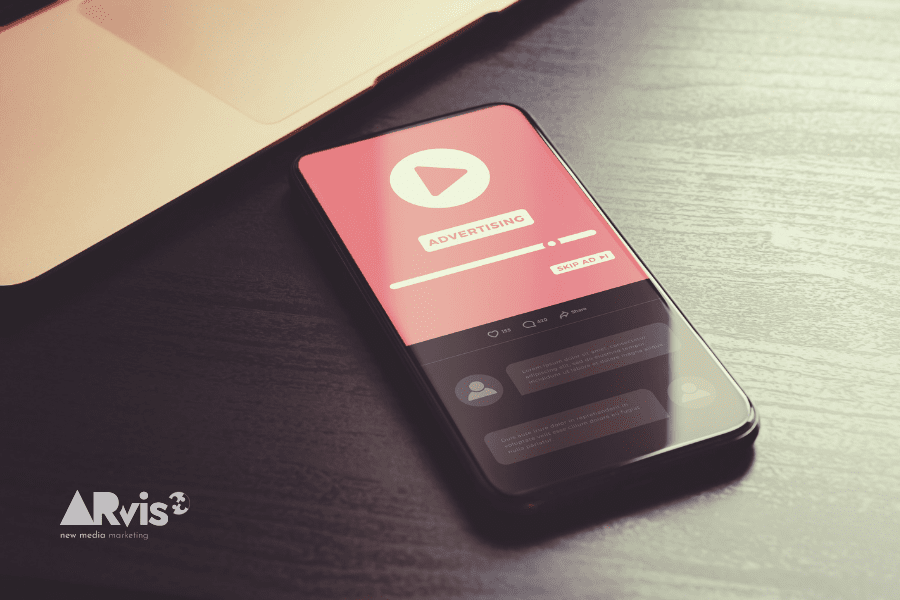
But what is YouTube ads for? Certainly for branding, delivering key and eye-catching messages in the few seconds of advertising video that precede the actual content the user wants to watch.
One advantage of YouTube is that, being part of Google, the platform for advertising is the same one used for Google advertising. This means that the targeting options are also the same. Therefore, it will be possible to select the most on-target audience segments to reach the people most interested in your brand.
Finding the right niche with advertising on Pinterest
When it comes to visual discovery, no social network is like Pinterest. Although still somewhat niche compared to Meta or YouTube, Pinterest has a large number of active and engaged users. Its target audience and its purpose as a social network are clear: it is a visual discovery platform where you can find the right inspiration and, on the other hand, provide inspiration to other users.
Advertising on Pinterest ads, therefore, can be very effective if it identifies the right audience niche to inspire. In sectors such as home furnishing and food, a social network like Pinterest can really make the difference, both in terms of brand awareness and conversions.
Why do social advertising on LinkedIn?
The situation is completely different for LinkedIn. While the other social networks are platforms for leisure, on which to spend your free time, LinkedIn is a social network dedicated to professionalism and the world of work. This means that users have a completely different way of using it, one that is more formal and professional. At the corporate level in particular, LinkedIn is the institutional social network par excellence, almost a kind of extension of the website.
This is why the tone and creative assets of LinkedIn content will need to be different, both at the organic and the advertising level.
In particular, LinkedIn ads is recommended for B2B advertising. Companies and freelance professionals with the goal of building valuable relationships and leads for potential clients can strategically place ads on LinkedIn as part of a broader advertising strategy.
Related service: discover Advertising by ARvis — the agency that scales with you.